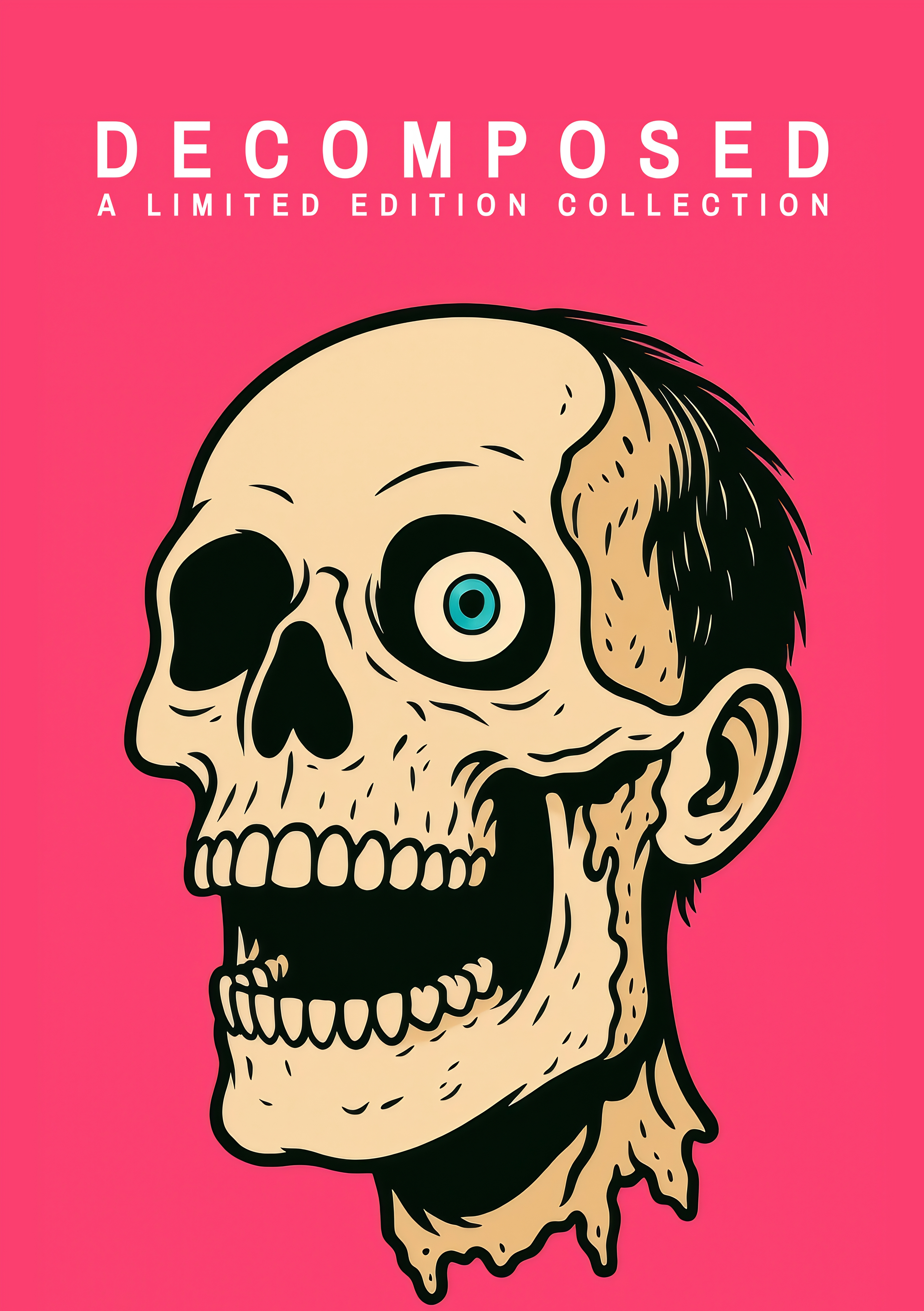
DEAD STRAIGHT LINES
Garrett learned early that straightness was a lie. In the seventies, before the tobacco stains on his fingers had become permanent - before the old skin smell, he sat in a student flat where the curtains were never fully open and argued about the shape of the world with a fellow student.
“Nothing’s truly straight,” Simon said, voice flattened by smoke. “You draw, you zoom in, and there are burrs. A laser? Dust and air make it dance.” He traced an imaginary ruler-line in the air and bumped it gently with his knuckle. Garrett watched the gesture as if a priest had lifted a wafer.
He had laughed because that is what you do in a conversation like that, but something in him took hold. The idea was stupid and trivial and therefore perfect - a private dare. Find a dead straight line. Not Euclid on a chalkboard, not a line that is a line until you look closely. He wanted a line that would not flinch under zoom. A line that, if brought to the eye of God, would embarrass the Almighty for having nothing to correct.
An obsession began – and he became irritable, difficult; Simon called him “tally marks” because he counted small betrayals like not replacing yogurts in the fridge. He learned how to end a conversation by looking at a clock that was not there. It worked. At twenty-two, he had mastered emptying a room - simply by being present.
In the microscopy lab he borrowed time he was not supposed to have, pencilling lines on acetate with a ruler, dragging a blade down the acetate to see how plastic healed. Under the scope the graphite edges were a chewed coastline. At the highest magnification the jaggedness became landscape - stalagmites, craters and pine forests. He felt both thrilled and insulted. The insult was important. It brazed the obsession permanently onto him.
He became a microbiologist. The bacteria were obedient. You kept them at 37°C, fed them sugar water and they reproduced happily without ever asking what you thought of them. He wrote papers about plasmids, about efflux pumps, about resistance patterns in hospital sinks. The work was fine, accurate, useful; it kept him indoors and away from people.
Everyone in the department had their private research, their corner of the map they believed was the only place that mattered. Garrett’s map had a cliff at its edge. Beyond it: geometry not taught to undergraduates and forums with names he would not share with colleagues. He read about Brownian motion, about thermal noise in lattices, about how even a crystal - that symbol of order - ripples at its edges at any temperature above zero. He read about beam bending, about the Euler–Bernoulli equation, about residual stress along an edge where the polishing was poor.
He kept notebooks that were more catalogue than diary. Entries were dated and cross-referenced. He never wrote the names of people - he wrote their job titles, their experiments. “Tech in Cell Culture: breath smells of coffee,” one line reads, then an arrow into a diagram of a light path.
The students who drifted through his lectures saw only the brittle professor who did not tolerate guesses. He cut them off with a smile that was not friendly and corrected their pronouns when they used “we” to include him in their imagined cohort. “You,” he would bellow. He watched them flinch, and in the flinch felt a tic of joy.
He had one attempt at something like a marriage, with Hannah the librarian. She wanted a dining table and he wanted a bench. She wanted a holiday and he wanted a stable power supply for the servo system he was building in the spare room. The night she asked if he loved her he answered two minutes too late, and in those two minutes the thing they had built together had sprung a leak and gone down like a cheap inflatable on arctic waters. She left behind a mug, a scarf and a tiny brown paint spot on the tobacco-white wall above the headboard. He kept the spot, touching it as he fell asleep, as if it were a button that could return him to some earlier configuration. It never did.
He built the machine with grant leftovers, some of his own money and a useful lathe left to him by his father. The lab technicians learned to ignore the deliveries; vacuum pumps, a stainless steel chamber that looked like a coffin, steel rails and ultra smooth bearings. The blade was the part he treated as if it were alive. He worked the steel into a fine edge - he dressed it with powders, with diamond slurry and with the occasional ritual.
The machine was three nested systems. First, the chamber: a low-pressure box evacuated by a pair of pumps, one rotary, one turbo. Inside the chamber a gimbal held the blade. The gimbal sat on piezoelectric actuators that could move the blade a few microns at a time in any direction. The motor that swung the blade was an old friend he fed perfectly regulated current. The second system: sensors. Laser vibrometers mapped the tremble of the world; interferometers measured how the blade wandered from its assigned path. The third system was a feedback loop that learned the room’s rhythms. He wrote code at night that predict effects on the building when a lorry went by and the microseism of the sea a hundred kilometres away. He taught the machine to love stillness.
He swung the blade at different speeds and angles, sometimes slicing paper taped to a frame, other times cutting smoke from a mineral oil generator. He watched the footage slowed to twenty thousand frames per second. Alone in the lab, he sang to the machine. Not songs from his childhood - those he could not bear - but monotone recitations of notes and calculations. He could stand himself for hours at a time if he kept the voice down to a hum, just one more parameter that could be filtered out. He became good at filtering. He filtered hunger, guilt, his memories.
On the day he made the cut he had already failed twice. He was good at failure now. He recorded it with the neutrality of a coroner. “Run 3127: minor bow observed under 4500 rpm; adjustment +0.2 mrad not sufficient.” He would replay the footage and draw the deviation on a transparent overlay.
On his third experiment of the day he heard a sound like a snapped violin string and a clatter inside the chamber. The mount had slipped. Not far, not catastrophically, but enough. He swore aloud, a neat private litany. He swore again, uglier. Something in him rose - a pressure he had put off for forty years. He unlocked the chamber, killed the pumps and opened the lid. He lifted the blade from its housing and felt its weight fully in his left arm.
No living person would have recognised the sound that came out of him as human. He swung the blade as if cutting down a hanging rope. The arc shattered glassware and sent a row of test tubes to the ground. He swung again at nothing. The third swing entered the air with a speed he would usually never risk, his muscles translating forty years of measured restraint into a single gesture. The motion cut a line.
What opened was not theatrical. It had no spokes of divine machinery. Around the slit, the room went wrong. The bench and the floor seemed to tilt toward it and away from it at the same time, like the slit were covered with a lens with a perverse focal length. The line he had drawn was “right”. Not “close.” Not “good enough for publication.” Perfect straightness existed.
He stepped toward it. Beyond, he could not see a world and yet knew there was one. The colour resembled hospital strobe lighting. He raised his hand, not to touch, just to measure. As his fingers drew close to the fluorescence, something from the other side met him. It was not a hand, not really. It made contact the way treacle contacts a spoon. The viscous mass gripped his arm and rolled over his shoulder to the back of his head, then the mass caressed his temples, as if scanning the inside of his skull.
Garrett was not a sturdy man. The mass squeezed and his skull gave way with little resistance. Pain tore him through. He heard a sound from inside him like a wet mop slapped to a tiled floor. The mass released and he fell forward. The laboratory did what rooms do when no one is in them: it settled. The monitors ran out of buffer and stopped recording. The vacuum pumps were off. The slit healed.
People would talk, of course. A cleaner would find him and say something about “one of the professors” and remember some encounter, inaccurately. A committee would meet and draft a gentle announcement. The head of department would refute quietly any rumours with the words “tragic accident.” Simon would buy two tequilas and say, “He was always . . . intense,” and leave “awful” unsaid.
Garrett has spent every spare moment in pursuit of a dead straight line – and learned in a few short seconds - there are lines you do not cross.
As you've seen already - We don't paywall - we don't track - we don't display ads. All reading here is provided for free. Once a year in June, all donated funds are split between our authors as a thanks for their contribution. If you like our content, please contribute to the fund.
Donate via Paypal or Credit / Debit Card